
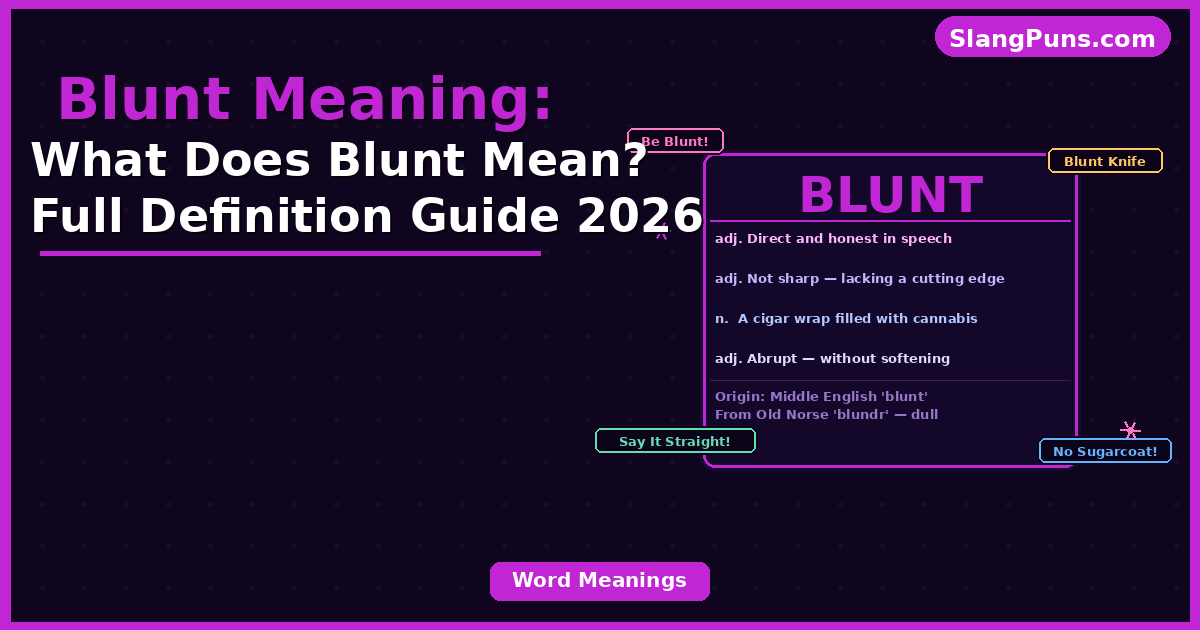
The word “blunt” has several distinct meanings — and if you have been confused by seeing it used in completely different ways in different conversations, you are not alone. The blunt meaning varies significantly depending on whether someone is describing communication style, a type of object, cannabis slang, or the literal sharpness of an edge. This complete guide covers every blunt meaning clearly and completely.
Blunt Meaning — All Definitions at a Glance
| Context | Blunt Meaning | Example |
|---|---|---|
| Communication / Personality | Direct, honest, not softening words — saying exactly what you mean | “She is very blunt — she will tell you exactly what she thinks” |
| Physical object | Not sharp — a blade or edge that has lost its sharpness | “This knife is blunt — it needs sharpening” |
| Cannabis slang | A cigar emptied and refilled with cannabis | “They rolled a blunt and sat on the porch” |
| General adjective | Abrupt, without subtlety or softening | “A blunt refusal with no explanation” |
Blunt Meaning #1 — Direct and Honest Communication
The most common blunt meaning in everyday conversation describes a communication style — being direct, honest, and unfiltered without softening your words to spare someone’s feelings. A blunt person says exactly what they think without diplomatic cushioning:
- Blunt feedback — honest criticism without softening — “this needs a complete rewrite”
- Blunt person — someone who consistently says what they mean directly
- Being blunt — choosing to say something directly rather than diplomatically
- “To be blunt” — a phrase used before delivering direct, unfiltered honesty
Blunt vs Rude — What Is the Difference?
Being blunt is not the same as being rude — this is one of the most important distinctions in the blunt meaning. A blunt person is honest and direct but not necessarily unkind or disrespectful. Rudeness involves a lack of consideration for others. Bluntness involves a preference for directness over diplomatic softening. Someone can be blunt and kind simultaneously — the message is direct but delivered without cruelty. The difference lies in intent: blunt people prioritize honesty; rude people prioritize dominance or disregard.
Blunt Meaning #2 — Not Sharp
In its most literal physical sense, blunt means not sharp — a blade, needle, pencil, or edge that has lost its point or cutting ability:
- “The scissors are blunt — they are tearing rather than cutting”
- “A blunt pencil makes thick, imprecise lines”
- “The surgeon requires sharp instruments — blunt tools cause more damage”
This literal blunt meaning is also used metaphorically — “a blunt instrument” describes an approach that is crude, imprecise, or lacking in subtlety, even in non-physical contexts. “Using a sledgehammer as a blunt instrument when a scalpel was needed” describes an overly forceful approach to a delicate situation.
Blunt Meaning #3 — Cannabis Slang
In cannabis culture and American slang, a blunt is a cigar that has been emptied of its tobacco and refilled with cannabis. The blunt is rolled using the cigar’s tobacco leaf wrapper, which burns more slowly than standard rolling paper and gives the smoke a distinctive flavor. Key details about this blunt meaning:
- Materials — typically made using a cigar (Swisher Sweets, Dutch Masters, and Backwoods are popular choices) or cigar wraps sold specifically for this purpose
- Size — generally larger than a joint (which uses rolling paper) — blunts typically contain more cannabis
- Burn time — burns slower and longer than a joint due to the thicker tobacco leaf wrapper
- Flavor — the tobacco leaf adds a distinct flavor that many users prefer
- Origin — the blunt as cannabis slang originated in New York hip-hop culture in the 1980s and spread nationally through music
How to Use Blunt in a Sentence
- “To be blunt, I think the plan needs major changes.” — direct communication
- “She is one of the most blunt people I have ever met — she never sugarcoats.” — personality
- “This razor has gone blunt — time to replace it.” — physical sharpness
- “A blunt instrument of policy that ignores individual circumstances.” — metaphorical
Frequently Asked Questions About Blunt Meaning
What does it mean when someone calls you blunt?
When someone calls you blunt it means you communicate directly and honestly without softening your words. Being called blunt can be a compliment or a mild criticism depending on context and tone. As a compliment it means you are refreshingly honest and people always know where they stand with you. As mild criticism it suggests you could benefit from more diplomatic delivery. Most people who are described as blunt consider it a positive quality — they value directness and find excessive softening dishonest.
Is being blunt a good thing?
Being blunt is generally considered positive in contexts that value honesty and directness — close friendships, professional feedback situations, and relationships where both parties prefer clear communication. It can be less effective in situations requiring diplomacy, sensitivity, or careful navigation of power dynamics. The key to being productively blunt is combining directness with genuine care for the other person — saying difficult truths clearly while still being respectful of the person’s feelings.
What is the difference between a blunt and a joint?
A blunt and a joint are both rolled cannabis products but differ in their wrapping material. A joint is rolled using thin rolling paper — typically white or unbleached — and contains only cannabis. A blunt is rolled using a tobacco leaf wrapper from a cigar or cigar wrap — which is thicker, burns slower, and adds a tobacco flavor. Blunts are generally larger than joints and take longer to smoke. The tobacco leaf wrapper is the defining characteristic of a blunt.
Where does the word blunt come from?
The word blunt comes from Middle English “blunt” or “blont” — possibly related to Old Norse “blundr” meaning to doze or have dull senses. The connection between physical dullness (a blunt blade) and mental or communicative dullness (blunt speech) developed naturally in English over centuries. The cannabis slang meaning emerged in New York hip-hop culture in the 1980s, popularized through rap music and spreading nationally through the 1990s and 2000s.
What does “to be blunt” mean at the start of a sentence?
“To be blunt” is a phrase used before delivering direct, honest feedback or opinion — it signals to the listener that what follows will be unfiltered and straightforward rather than diplomatically softened. “To be blunt, your presentation was not ready” means the speaker is choosing honesty over comfort and wants the listener to understand they are receiving direct feedback. It is a form of conversational transparency — warning someone that directness is coming so they can receive it as intended rather than as an attack.
Blunt Meaning: The Complete Picture
The blunt meaning covers a surprisingly wide range — from the directness of honest communication to the literal dullness of an unsharpened blade to the specific cultural object of cannabis culture. What connects all these meanings is a shared sense of lack of refinement or softening — blunt communication does not soften, a blunt blade does not cut finely, and a blunt in cannabis culture is a deliberately unsubtle, large, slow-burning alternative to the more refined joint. In all its uses, blunt means something that gets straight to the point — or notably fails to.