
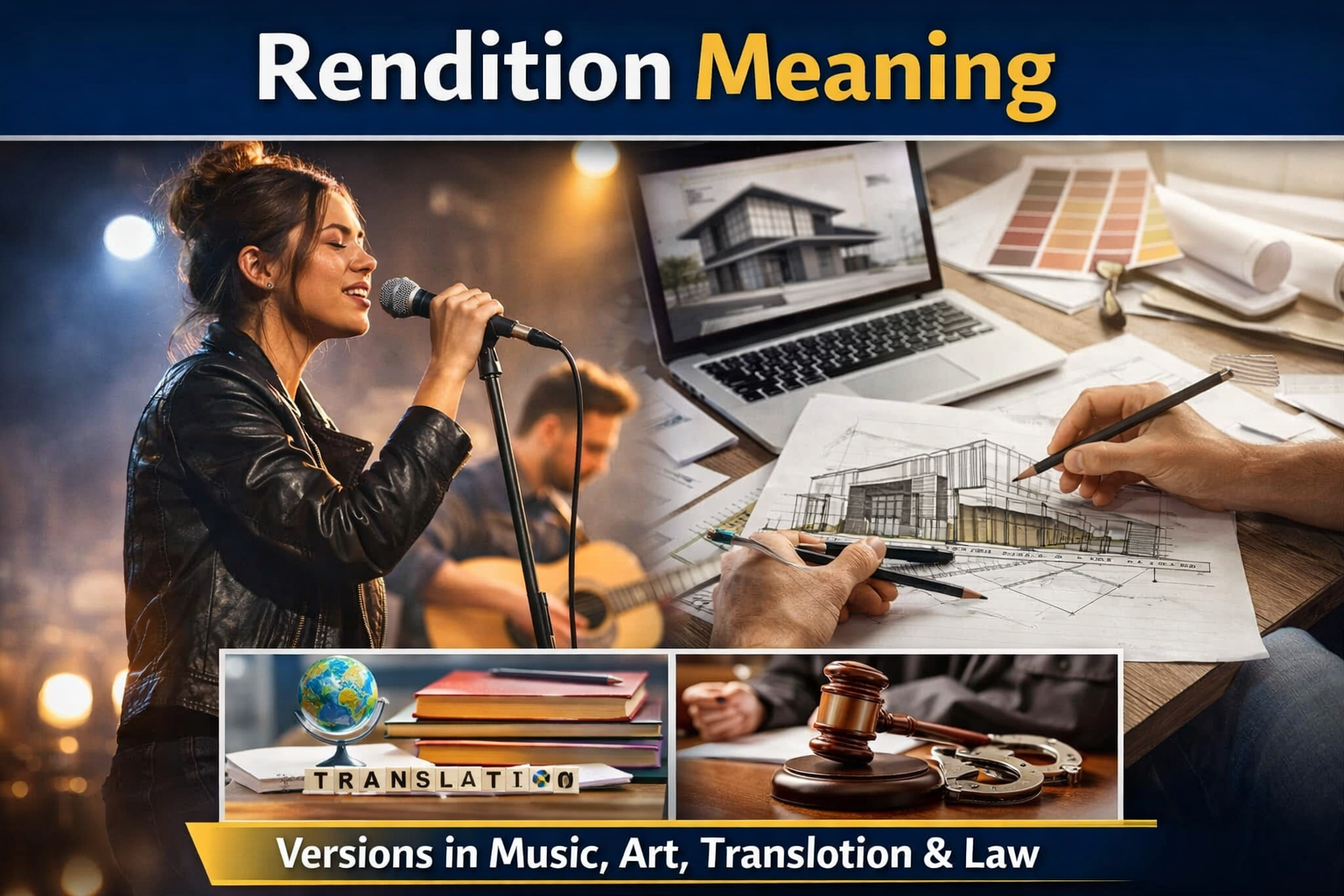
The phrase “rendition meaning” is commonly searched by people trying to understand how the word is used in music, art, language, and even legal contexts. While the term may sound formal, it appears regularly in everyday English. You might hear someone praise a singer’s rendition of a classic song or read about legal rendition in news reports.
At its core, a rendition is a version, performance, interpretation, or translation of something. The exact meaning changes slightly depending on the context. In music, it refers to a performance style. In literature, it can mean a translation. In law, it may refer to the transfer of a person from one jurisdiction to another.
This guide explains the full meaning of rendition, where the word comes from, how it is used in different industries, and how to use it correctly in conversation and writing.
What Does Rendition Mean?
The word “rendition” is a noun that generally refers to the act of presenting, performing, translating, or interpreting something in a specific way. Dictionaries commonly define it as a performance, version, or translation of an existing work.
A simple way to understand the term is this:
A rendition is someone’s particular way of expressing or presenting something that already exists.
For example:
- A singer may perform a rendition of a famous song.
- An artist may create a rendition of a landscape.
- A translator may produce an English rendition of a foreign text.
The word often suggests a personal touch or interpretation rather than an exact copy.
Origin and History of the Word
The word “rendition” comes from the Latin root reddere, meaning “to return” or “to give back.” Over time, it evolved through French and entered English in the early 1600s.
Its connection to the verb “render” is important. The verb “render” can mean:
- To perform
- To translate
- To provide
- To depict
Because of this, “rendition” developed several meanings that are still used today.
Rendition Meaning in Music
A Performance With Personal Style
The most common modern use of rendition appears in music. A rendition of a song refers to a particular performance or interpretation of that song.
For instance, if a singer performs a classic Beatles song in a slower acoustic style, that performance is considered their rendition of the song.
This usage highlights creativity and interpretation. The performer may change:
- Tempo
- Vocal style
- Instrumentation
- Mood
- Arrangement
A rendition does not need to copy the original exactly. In fact, audiences often appreciate renditions because they offer a fresh perspective.
Examples in Everyday Language
Here are a few common sentences:
- “Her rendition of the national anthem impressed the crowd.”
- “The pianist delivered a beautiful rendition of Mozart’s work.”
- “The band performed a jazz rendition of a pop hit.”
In each example, rendition refers to a specific performance style.
Rendition vs Cover Song
People often confuse “rendition” with “cover.” They are related but not identical.
A cover song is simply a new recording or performance of an existing song. A rendition emphasizes interpretation and artistic expression.
A singer can perform a cover without changing much. A rendition usually suggests a more distinctive presentation.
Musicians and music enthusiasts often use the term to describe performances that add originality or emotional depth.
Rendition Meaning in Art and Literature
Artistic Interpretation
In visual art, rendition refers to the depiction or representation of something. An artist’s rendition is a visual interpretation rather than a photographically exact image.
Architects frequently use the phrase “artist’s rendition” when presenting future building designs. These images help people imagine what a project will look like once completed.
For example:
- “The brochure included an artist’s rendition of the new stadium.”
- “The magazine published a digital rendition of the spacecraft.”
This meaning focuses on creative representation.
Translation and Language
In literature and language studies, rendition can mean a translation of a text from one language into another.
For example:
- “The English rendition of the poem captured the original emotion.”
- “Scholars debated the most accurate rendition of the ancient manuscript.”
In this context, rendition means a translated or interpreted version of written content.
Rendition Meaning in Law
Legal Transfer or Surrender
The legal meaning of rendition is more serious and less commonly used in casual conversation. In law, rendition refers to the transfer or surrender of a person from one jurisdiction to another.
This can happen when:
- A fugitive is sent back to another state
- A suspect is transferred between countries
- Authorities cooperate across borders
The term is closely related to extradition.
Extraordinary Rendition
You may also hear the phrase “extraordinary rendition,” especially in political or international news discussions. This term became widely known during debates about counterterrorism policies in the early 2000s.
In that context, extraordinary rendition refers to transferring suspects to another country for detention or interrogation outside normal legal procedures.
Because of its political and legal implications, this usage carries a very different tone from the artistic meaning of rendition.
Common Synonyms of Rendition
Depending on context, several words can replace rendition.
In Music or Art
Possible synonyms include:
- Performance
- Interpretation
- Version
- Arrangement
- Adaptation
In Translation
Possible alternatives include:
- Translation
- Rendering
- Conversion
In Legal Contexts
Possible synonyms include:
- Extradition
- Transfer
- Surrender
- Handover
Different dictionaries and language references list many of these as related terms.
How to Use “Rendition” Correctly
Correct Usage Examples
The word is most natural when discussing performances, artistic works, or interpretations.
Examples:
- “His rendition of the poem moved the audience.”
- “The chef created a modern rendition of a traditional dish.”
- “The movie is a dark rendition of the original novel.”
Notice how the word implies a unique presentation or style.
Common Mistakes
Some English learners use rendition in situations where “variation” or “version” would sound more natural.
For example:
- Incorrect: “My surname has many renditions.”
- Better: “My surname has many variations.”
Native speakers usually associate rendition with performance or interpretation rather than simple differences.
Rendition vs Rendering vs Arrangement
These related words often confuse learners because they share similar roots.
Rendition
Usually refers to a performed or interpreted version of something.
Example:
- “Her rendition of the song was emotional.”
Rendering
Often refers to the process of depicting or creating something visually.
Example:
- “The architect showed a 3D rendering of the building.”
Arrangement
Usually refers to adapting music for different instruments or styles.
Example:
- “The orchestral arrangement sounded dramatic.”
Musicians and music theorists often distinguish these terms carefully.
Why the Word “Rendition” Matters
Rendition is a powerful word because it emphasizes interpretation rather than duplication. It suggests that the person presenting the work adds something personal, emotional, or creative.
That is why the term appears so often in:
- Music reviews
- Film criticism
- Art discussions
- Literary translation
- Legal reporting
Understanding the nuance behind the word helps improve both vocabulary and communication skills.
Frequently Asked Questions
Q: What is the simple meaning of rendition?
A: A rendition is a particular version, performance, or interpretation of something. It is commonly used for songs, artwork, translations, and performances.
Q: What does rendition mean in music?
A: In music, rendition refers to a performer’s unique interpretation of a song or composition. It may differ from the original through style, tempo, vocals, or arrangement.
Q: Is rendition the same as translation?
A: Sometimes. In literary or language contexts, rendition can mean a translation of a text. However, the word also has broader meanings related to performance and interpretation.
Q: What is an artist’s rendition?
A: An artist’s rendition is a visual representation or interpretation of something, often used for future buildings, inventions, or imagined scenes.
Q: What does rendition mean in legal terms?
A: In law, rendition refers to the transfer or surrender of a person from one jurisdiction to another, often related to extradition or detention procedures.
Conclusion
Understanding the rendition meaning becomes much easier once you see how the word changes across different contexts. In music and art, it usually describes a creative interpretation or performance. In literature, it can refer to translation. In law, it relates to transferring individuals between jurisdictions.
Although the meanings vary, they all share a common idea: presenting or delivering something in a particular form. Whether you are discussing a singer’s emotional performance, an architect’s design sketch, or a translated text, rendition remains a versatile and expressive English word.
Learning how to use it naturally can make your communication sound more polished, precise, and fluent.