
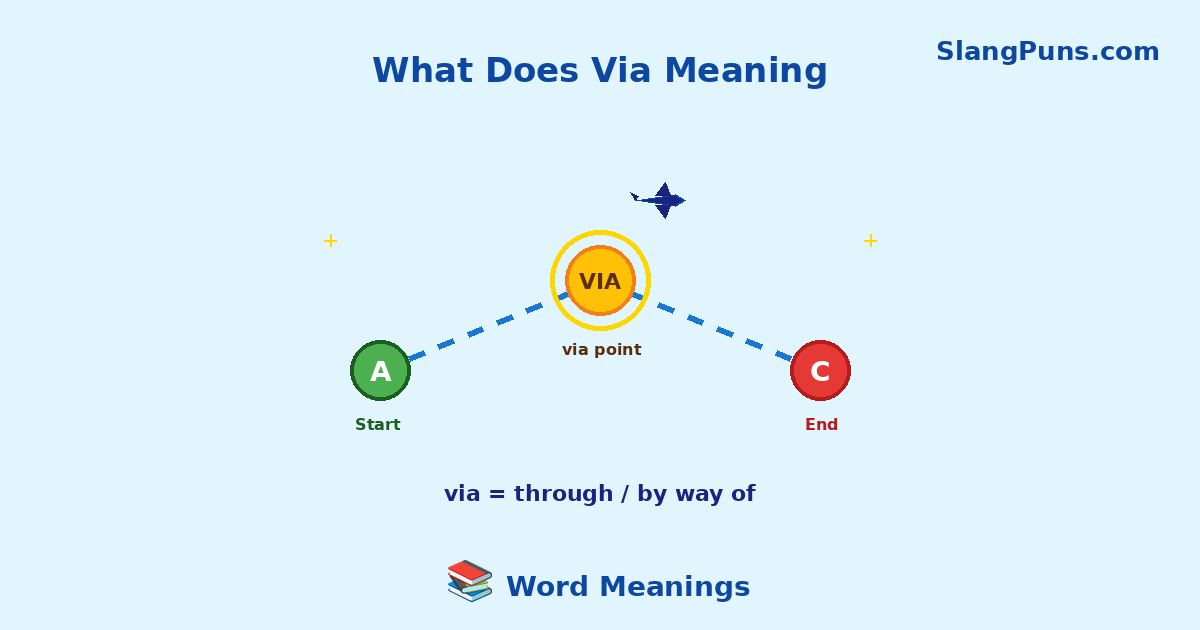
Have you ever seen the word “via” used in a sentence like “she sent it via email” or “we traveled via Paris” and wondered exactly what it indicates? Understanding what does via meaning reveals one of the most useful little words in English. The full answer to what does via meaning convey opens up clear communication about routes, methods, and channels — appearing constantly in everyday writing and speech.
What Does Via Meaning — The Core Definition
The full answer to what does via meaning carry is this: it means “through,” “by way of,” or “by means of”. The word indicates a path, route, channel, or method used to accomplish something. To put what does via meaning briefly: it tells you the way something travels or how something is done.
- Travel routes — “flew to Tokyo via Hong Kong”
- Communication methods — “contacted me via email”
- Information sources — “learned via the news”
- Process methods — “delivered via courier”
In simple terms, what does via meaning come down to: it is the precise word for indicating the route taken, channel used, or means employed in any context.
Breaking Down What Does Via Meaning Describe
The Latin Origin of What Does Via Meaning
To trace what does via meaning back to its roots, the word comes directly from Latin where “via” simply means “road” or “way.” Latin roads were extensive — the famous Roman roads like the Via Appia connected the Roman Empire across thousands of miles. From this literal meaning of road, what does via meaning evolved into the modern English sense of “by way of” or “through.”
Why What Does Via Meaning Is So Useful
What does via meaning convey is concise — a single short word that replaces longer phrases like “by way of” or “through the use of.” This efficiency makes the word particularly useful in formal writing, business communication, and travel descriptions. Saying “I sent the file via email” sounds cleaner than “I sent the file through the use of email.”
The Two Main Senses
What does via meaning describe falls into two related senses. First, the physical route sense — “traveled via Berlin” indicates a stopover or path. Second, the method sense — “communicated via phone” indicates the means used. Both senses share the core idea of “by way of” but apply it to either physical paths or abstract methods.
Real Examples of What Does Via Meaning
Travel Examples
- “The train goes from London to Edinburgh via York.”
- “We flew to Sydney via Singapore.”
- “The bus reaches the airport via the city center.”
- “They drove home via the coastal route.”
Communication Examples
- “Send me the report via email.”
- “She contacted us via WhatsApp.”
- “The announcement came via official press release.”
- “He learned about the job via LinkedIn.”
Information and Source Examples
- “I heard the news via my neighbor.”
- “The story spread via social media.”
- “Information came via official channels.”
- “Updates arrived via the newsletter.”
How to Use What Does Via Meaning Correctly
Sentence Position
What does via meaning express works in the middle of sentences, connecting the action to the means or route. Examples:
- “Information was sent via fax.” (action + via + means)
- “The journey via the mountains was beautiful.” (description + via + route)
- “Updates arrived via email this morning.” (action + via + method + time)
Pronunciation of What Does Via Meaning
What does via meaning sound like when spoken? Two common pronunciations exist:
- VEE-uh — common in American and British English
- VYE-uh — also accepted, slightly more formal feel
Both pronunciations are correct and widely understood. Choose whichever feels natural to your speech pattern.
In Italic or Roman Type
What does via meaning convey in writing usually appears in regular Roman type, not italic. While “via” is technically Latin in origin, the word has been fully incorporated into English. Older style guides sometimes italicized it, but modern writing treats it as regular English.
Via vs Through vs By
- Via — formal, specific routes/methods
- Through — broader, more common, less formal
- By — most general, very casual
What does via meaning represent is slightly more formal than “through” or “by.” All three can often be substituted for each other, but “via” gives writing a more polished, specific feel — particularly useful in business and technical contexts.
When to Use What Does Via Meaning
Business and Professional Writing
What does via meaning convey works excellently in business contexts. Phrases like “delivered via courier,” “submitted via portal,” or “received via official channels” sound professional and precise. Business emails frequently use the word for clarity about communication methods.
Travel and Logistics
What does via meaning express is essential vocabulary in travel and shipping. Travel itineraries use “via” to indicate connecting points. Shipping companies use it for routing information. Maps and transit schedules feature the word constantly.
Academic and Technical Writing
What does via meaning represent appears frequently in academic and technical writing. Scientific papers describe how findings were “obtained via specific methods.” Technical documentation uses it for explaining processes. The word’s precision suits formal academic style.
Frequently Asked Questions About What Does Via Meaning
Q1: What does via meaning exactly?
The exact answer to what does via meaning describe is “through,” “by way of,” or “by means of.” The word indicates a path, route, channel, or method used to accomplish something. It applies to physical travel routes (“via Paris”), communication channels (“via email”), information sources (“via the news”), and methods of delivery (“via courier”). The word is precise and useful for indicating how something travels or how something is done.
Q2: Where does what does via meaning come from?
What does via meaning represent in terms of origin comes directly from Latin, where “via” means “road” or “way.” Latin roads like the famous Via Appia connected the Roman Empire across thousands of miles. From this literal meaning of road, the word evolved into the modern English sense of “by way of” or “through.” The word has been part of English vocabulary for centuries and is now fully naturalized.
Q3: How do you pronounce what does via meaning?
What does via meaning sound like when spoken? Two common pronunciations are accepted: “VEE-uh” (more common in everyday speech) or “VYE-uh” (slightly more formal). Both are correct and widely understood across English-speaking regions. Choose whichever feels natural in your speech pattern — there is no wrong choice between these two standard pronunciations.
Q4: What is the difference between via and through?
What does via meaning convey versus “through” is a subtle difference. Via is slightly more formal and often suggests a specific route, channel, or method. Through is broader, more common, and works in more casual contexts. You could say “traveled through Paris” or “traveled via Paris” — both are correct but via sounds slightly more polished. In business and technical writing, via often fits better. In casual conversation, through is more common.
Q5: Can what does via meaning start a sentence?
What does via meaning express typically appears mid-sentence connecting actions to means, but it can occasionally start sentences for emphasis. For example: “Via email, we received the news.” This usage is uncommon but grammatically acceptable. More natural placement is mid-sentence: “We received the news via email.” For most writing, place via between the action and the means or route for cleanest results.
What Does Via Meaning: The Complete Picture
The full answer to what does via meaning captures something perfectly useful in English — a precise short word that handles both physical routes and abstract methods with equal grace. From “flew via Tokyo” to “contacted via email” to “delivered via courier,” what does via meaning convey fills countless practical roles in modern communication. The word’s Latin origins as “road” lend it a timeless quality, while its modern usage spans travel, business, technology, and casual conversation. Anyone learning English should understand what does via meaning represent because the word appears constantly in everyday writing and speech. The next time you need to indicate a route or method clearly, reaching for “via” gives your communication the polished precision it deserves naturally.