
Have you ever sat in a geometry class and heard the teacher say two shapes are “congruent” and wondered what makes that different from saying they are equal or just the same? Understanding what does congruent mean in math opens up one of the most important concepts in geometry — a precise term that describes the exact relationship between shapes that match perfectly in every measurable way. The word may sound technical, but its meaning is actually quite intuitive once you see what it describes.
In everyday English, we might describe two things as “the same” or “matching,” but mathematics demands more precision. Congruent is the formal mathematical term that captures the idea of perfect geometric equality — two figures that could be picked up, moved around, flipped, or rotated and would still fit exactly on top of each other. This concept appears throughout geometry, trigonometry, and many areas of advanced mathematics, making it essential vocabulary for students at every level. Whether you are helping a child with homework, studying for a math exam, or simply curious about mathematical language, exploring the full meaning of congruent reveals fascinating depth in what seems at first like a simple word.
The Core Definition of Congruent in Math
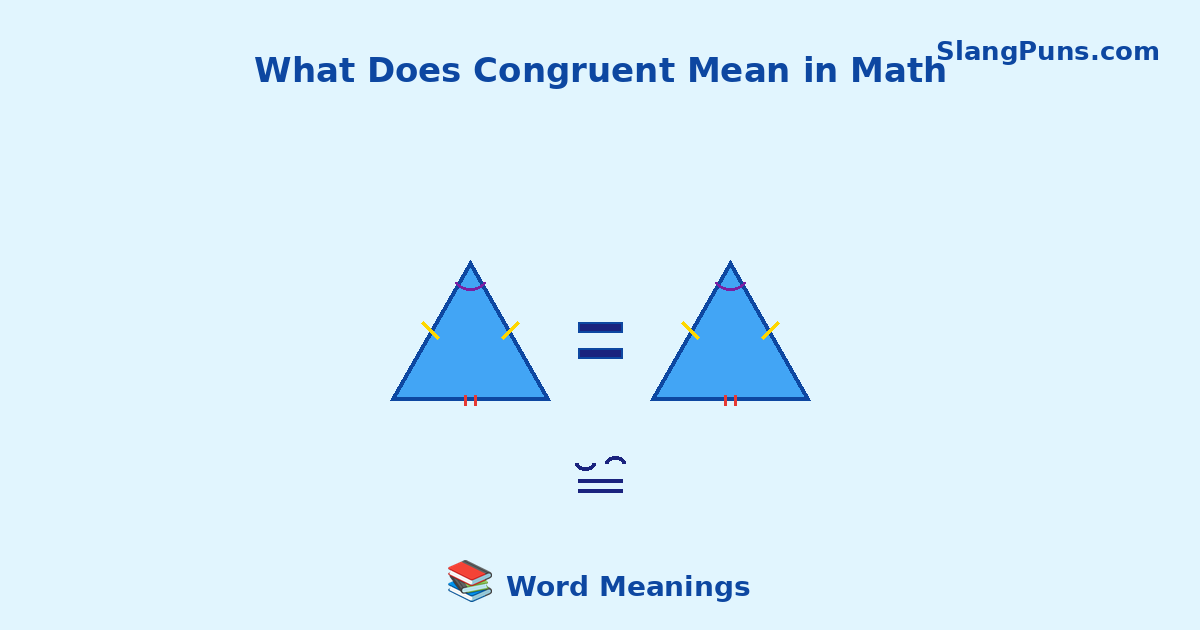
In mathematics, congruent means that two geometric figures have exactly the same size and shape. Two shapes are congruent if one can be transformed into the other through a combination of rotations, reflections, and translations — without any stretching, shrinking, or distortion. This means every corresponding side has the same length, every corresponding angle has the same measure, and the overall form is identical.
The Mathematical Symbol for Congruent
The symbol used for congruent in mathematics is ≅, which combines an equal sign (=) with a tilde (~). The equal sign part represents the idea that the shapes are equal in measurement, while the tilde represents that they are similar in shape. Together, they capture the full meaning of congruent — equal in both size and shape. When you write triangle ABC ≅ triangle DEF, you are stating that these two triangles are congruent, meaning every corresponding part matches exactly.
Congruent Versus Equal
One common point of confusion is the difference between congruent and equal. In math, “equal” typically refers to numerical values — 5 = 5 means the numbers have the same value. Congruent, however, refers to geometric figures and means the shapes themselves match in every way. Two line segments can be congruent if they have the same length, two angles can be congruent if they have the same measure, and two polygons can be congruent if all their corresponding parts match. This distinction is important because shapes that look similar might not actually be congruent unless every measurement matches precisely.
Congruent Versus Similar
Another related term is “similar,” which describes shapes that have the same form but different sizes. Two triangles can be similar if they have the same angles but different side lengths — like a small triangle and a large triangle that look the same but are different sizes. Congruent shapes are always similar, but similar shapes are not always congruent. The key difference is that congruent requires the shapes to be exactly the same size, not just the same shape.
Etymology and Origin of the Word Congruent
Understanding where the word congruent comes from helps explain its precise mathematical meaning. The word has a fascinating history that traces back through several languages, each layer adding to its current meaning in mathematics.
Latin Roots
The word congruent comes from the Latin “congruere,” meaning “to come together” or “to agree.” This Latin root combines “con-” meaning “together” and “gruere” meaning “to fall” or “to meet.” The original sense was of things meeting or fitting together properly, which translates beautifully into the mathematical concept of shapes that fit together exactly when superimposed.
Mathematical Adoption
While the general English meaning of congruent (meaning agreeable or harmonious) has existed for centuries, its specific mathematical use was popularized by the famous mathematician Carl Friedrich Gauss in the late 1700s and early 1800s. Gauss formalized the concept in his groundbreaking work on number theory and geometry, establishing the precise definition we use today. His influence is so profound that the symbol ≅ remains standard in mathematics worldwide.
Congruent Shapes in Geometry
The concept of congruence appears throughout geometry in many different contexts. Understanding how it applies to various shapes helps you recognize congruence when you encounter it in problems and proofs.
Congruent Line Segments
The simplest form of congruence involves line segments. Two line segments are congruent if they have the same length. Whether the segments are oriented horizontally, vertically, or at any angle does not matter — only their length determines congruence. In geometric notation, we write AB ≅ CD to indicate that the segment from A to B is congruent to the segment from C to D.
Congruent Angles
Two angles are congruent if they have the same measure in degrees or radians. A 45-degree angle is congruent to any other 45-degree angle, regardless of which direction the angle opens or how the rays are oriented. We write ∠ABC ≅ ∠DEF to indicate that two angles are congruent. This concept becomes important in proving theorems and solving geometric problems.
Congruent Triangles
Congruent triangles are perhaps the most commonly studied congruent shapes in geometry. Two triangles are congruent if all three corresponding sides are equal in length and all three corresponding angles are equal in measure. Several theorems help us prove triangle congruence without having to check all six parts, including SSS (Side-Side-Side), SAS (Side-Angle-Side), ASA (Angle-Side-Angle), and AAS (Angle-Angle-Side). Each theorem provides a shortcut for establishing that two triangles must be congruent based on limited information.
Congruent Polygons
The concept extends to all polygons. Two polygons are congruent if all their corresponding sides and all their corresponding angles are equal. For more complex shapes like pentagons or hexagons, this means matching all five or six sides and all five or six angles. The principle remains the same — every measurement must match exactly for the shapes to be considered congruent.
Triangle Congruence Theorems Explained
Because triangles are so fundamental in geometry, mathematicians have developed several theorems that allow us to prove two triangles are congruent without measuring every side and angle. These theorems are essential tools in geometric proofs.
SSS — Side Side Side
The SSS theorem states that if all three sides of one triangle are equal in length to all three sides of another triangle, then the triangles must be congruent. This makes sense because once you fix the three side lengths, the angles are determined automatically — there is only one possible triangle that can be made with three specific side lengths.
SAS — Side Angle Side
The SAS theorem states that if two sides of one triangle and the angle between them are equal to two sides of another triangle and the angle between them, the triangles are congruent. The angle must be the one between the two specified sides — this is called the “included angle.” This theorem works because once you fix two sides and the angle between them, the third side and the other two angles are uniquely determined.
ASA — Angle Side Angle
The ASA theorem states that if two angles of one triangle and the side between them are equal to two angles of another triangle and the side between them, the triangles are congruent. Again, the side must be the one between the two specified angles. Knowing the two angles determines the third angle (since angles sum to 180 degrees), and fixing one side then determines the entire triangle.
AAS — Angle Angle Side
The AAS theorem states that if two angles and a non-included side of one triangle are equal to two angles and the corresponding non-included side of another triangle, the triangles are congruent. This works similarly to ASA because knowing two angles determines the third, and any side along with all three angles uniquely determines the triangle.
HL — Hypotenuse Leg (for Right Triangles)
For right triangles specifically, the HL theorem states that if the hypotenuse and one leg of a right triangle are equal to the hypotenuse and corresponding leg of another right triangle, the triangles are congruent. This is a special case that works only for right triangles, taking advantage of the right angle being known.
Examples of Congruent Shapes in Real Life
The concept of congruence extends far beyond textbook geometry into many real-world applications. Recognizing congruent shapes around you helps make the mathematical concept feel more tangible and practical.
Manufacturing and Mass Production
Every time identical products are manufactured, they are essentially congruent. Two identical chairs from the same factory, two pages of the same book, two coins from the same minting — all are examples of congruent objects in everyday life. The principle of congruence underlies modern manufacturing, which depends on producing parts that are interchangeable because they are congruent to each other.
Tile Patterns and Architecture
Floor tiles, ceiling patterns, and many architectural designs rely on congruent shapes fitting together. When you see a tiled floor with identical square or hexagonal tiles, each tile is congruent to every other tile. This is why they fit together perfectly without gaps or overlaps. Similarly, the bricks in a wall, the panes in a window, or the planks of a wooden floor often feature congruent elements.
Nature and Symmetry
While nature rarely produces perfectly congruent shapes, many natural objects come remarkably close. The two sides of a butterfly’s wings are nearly congruent through reflection, snowflake patterns often have congruent sections through rotation, and crystalline structures display congruent faces. The mathematical concept helps explain and describe these patterns we observe in the natural world.
Art and Design
Artists and designers use congruent shapes intentionally for visual effects. Geometric patterns in textiles, repeating motifs in wallpaper, identical elements in logos — all rely on the principle of congruence to create balance and harmony. Islamic geometric art, in particular, is famous for its intricate patterns built from congruent shapes arranged in mathematically precise ways.
How to Determine if Shapes Are Congruent
When given two shapes and asked whether they are congruent, you have several approaches available depending on the information you have. Knowing these methods helps you solve geometry problems efficiently.
Direct Measurement
The most straightforward method is to measure all corresponding sides and angles. If every side of the first shape matches the corresponding side of the second shape in length, and every angle matches the corresponding angle in measure, the shapes are congruent. This method works for any pair of shapes but can be tedious for complex polygons with many sides.
Apply Congruence Theorems
For triangles specifically, you can use the SSS, SAS, ASA, AAS, or HL theorems to prove congruence without measuring everything. If you know enough information to apply one of these theorems, you can confidently conclude that the triangles are congruent. This is the most common approach in geometry proofs.
Use Rigid Transformations
Two shapes are congruent if one can be transformed into the other through rigid transformations — translations (sliding), rotations (turning), and reflections (flipping). If you can imagine moving one shape to fit perfectly on top of the other through these operations alone, the shapes are congruent. No stretching, shrinking, or distorting is allowed.
Common Mistakes When Working With Congruent Shapes
Students often make certain predictable mistakes when first learning about congruent shapes. Being aware of these pitfalls helps you avoid them in your own work.
Confusing Congruent and Similar
The most common mistake is treating “congruent” and “similar” as synonyms. Remember that congruent shapes must be exactly the same size, while similar shapes only need to have the same shape but can be different sizes. Always check both shape and size when determining congruence.
Wrong Order of Corresponding Parts
When writing congruence statements like triangle ABC ≅ triangle DEF, the order of vertices matters. The notation tells you that A corresponds to D, B corresponds to E, and C corresponds to F. Switching the order changes the meaning, so always pay attention to which vertices correspond when proving or applying congruence.
Assuming Visual Equality
Two shapes can look identical in a diagram but actually have different measurements. In geometry, you cannot assume shapes are congruent just because they appear similar in a picture. Always rely on given measurements, marked sides and angles, or proven theorems rather than visual estimation.
Frequently Asked Questions
Q1: What does congruent mean in simple terms?
Congruent in math means that two geometric shapes have exactly the same size and shape. If you could pick one shape up and place it perfectly on top of the other — possibly after rotating or flipping it — they would match exactly. Every side and every angle of one shape would match the corresponding side and angle of the other shape. The symbol ≅ is used to show that two shapes are congruent.
Q2: What is the difference between congruent and similar?
Congruent shapes have the same size AND the same shape, while similar shapes have only the same shape but can be different sizes. Two triangles can be similar if their angles match but their sides are different lengths — like one small triangle and one large triangle of the same form. Congruent shapes are always similar, but similar shapes are not always congruent. The key difference is that congruence requires identical measurements throughout.
Q3: What is the symbol for congruent?
The mathematical symbol for congruent is ≅, which combines an equal sign (=) with a tilde (~) on top. The equal sign represents equality in measurement, while the tilde represents similarity in shape. Together they convey the full meaning of congruent — equal in both size and shape. When you see this symbol between two shapes or measurements, it means they are perfectly identical in their geometric properties.
Q4: How do you prove two triangles are congruent?
You can prove two triangles are congruent using one of several theorems: SSS (all three sides equal), SAS (two sides and the included angle equal), ASA (two angles and the included side equal), AAS (two angles and a non-included side equal), or HL (hypotenuse and one leg equal, for right triangles only). Each theorem requires specific information to apply, but once you can show that one of these conditions is met, the triangles are proven congruent.
Q5: Can congruent shapes be flipped or rotated?
Yes, congruent shapes can be in different orientations through rotation, reflection (flipping), or translation (sliding). These are called rigid transformations because they do not change the size or shape of the figure. Two shapes can be congruent even if one looks like a mirror image of the other or is rotated to a different angle. As long as you could transform one shape into the other through these operations without stretching or shrinking, they are congruent.
Conclusion
Understanding what congruent means in math gives you access to one of geometry’s most fundamental concepts. The word describes the precise mathematical relationship between two shapes that match exactly in every measurable way — same size, same shape, same everything. From its Latin roots meaning “to come together” through its modern mathematical use formalized by Gauss, the term has carried the consistent meaning of perfect geometric agreement.
The applications of congruence extend far beyond textbook problems. Every manufactured product that is identical to another, every tile in a uniform pattern, every brick in a wall, every panel in a window — all are real-world examples of congruent shapes that make modern life possible. Without the principle of congruence, mass production, architecture, and engineering as we know them would be impossible. The mathematical concept directly enables practical creation of identical objects that fit together perfectly.
For students of geometry, mastering congruence opens doors to more advanced mathematical thinking. The theorems for proving triangle congruence — SSS, SAS, ASA, AAS, and HL — provide essential tools for geometric proofs. These methods teach logical reasoning and the discipline of deriving conclusions from given information, skills that transfer far beyond mathematics into many areas of life. Understanding when shapes must be congruent based on limited information develops the kind of analytical thinking that mathematicians value most.
The distinction between congruent and similar is one that often confuses students initially, but once understood, it reveals the precision that mathematics demands. While “similar” describes shapes that share form but may differ in size, “congruent” requires exact identity in every measurable way. This precise language allows mathematicians to communicate with absolute clarity about geometric relationships, avoiding the ambiguity that ordinary language sometimes permits. The symbol ≅ that combines equality and similarity beautifully captures this precise meaning in a single elegant notation.
Whether you are a student grappling with your first geometry class, a parent helping with homework, or simply someone curious about mathematical language, congruent represents a beautiful example of how mathematics takes everyday concepts like “the same” and refines them into precise, useful tools for understanding the world. The next time you see two identical shapes — whether in a textbook diagram or in the everyday objects around you — you can now appreciate the deep mathematical truth that they are not just similar but congruent, sharing every geometric property in perfect agreement.